HER ABSENCE HAD A SHAPE
Cloth that remembers a body, blank journals, a woman-shaped hollow in the earth, and what
remains after we leave.
ON MY TABLE
Terry Tempest Williams, When Women Were Birds
Sometimes what passes between women is not a story. Sometimes it is the shape of what
could not be said.
Before Terry Tempest Williams’s mother died, she told her daughter that she was leaving her
all her journals. There was one condition. She must promise not to read them until her mother
was gone.
After her death, Williams found them exactly where she had been told they would be. Three
shelves of beautiful cloth-bound books. Floral. Paisley. Solid colours. Their spines carefully
aligned.
She opened the first.
Blank.
Then the second.
Blank.
The third.
Blank.
Shelf after shelf after shelf.
Every journal her mother had left her was empty.
Williams writes:
“When I opened my mother’s journals and read emptiness, it translated to longing.”
I keep thinking about that. A woman leaves her daughter the record of her life. And the
record contains no words.
I found myself reading this book slowly. It moves through grief by way of mothers, birds,
water, language and silence. The blank journals kept following me. I kept wondering what it
is to be left something that contains almost nothing, and still find yourself changed by
receiving it.
What do we inherit from what was never said?
The daughter does inherit something. Perhaps absence is rarely as empty as it first appears.
Sometimes it has edges.
A hollow in a mattress.
A particular cup nobody else uses.
A coat still hanging on the back of a door.
Her mother’s shoes waiting patiently for her return, by the back door.
The pale rectangle on a wall after a picture has been taken down.
Things disappear strangely.
Sometimes what is left seems to become more visible because the person, or thing itself, has
gone.
I am a searcher...
I always was... and I still am ... searching for the missing piece.
- Louise Bourgeois
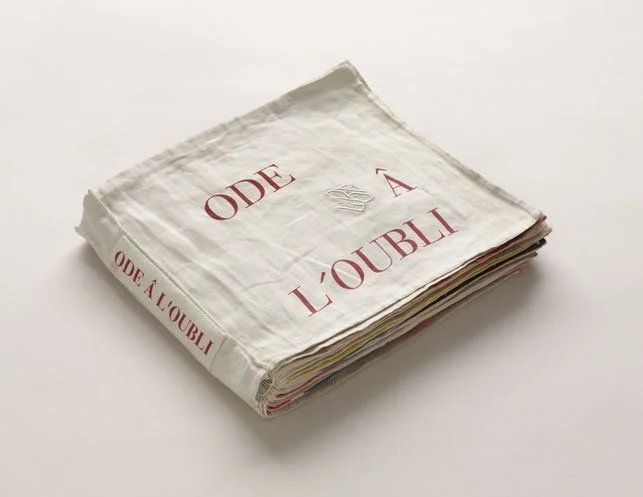
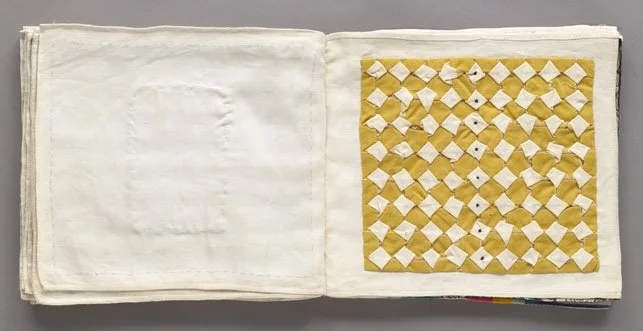
LOUISE BOURGEOIS, ODE À L’OUBLI
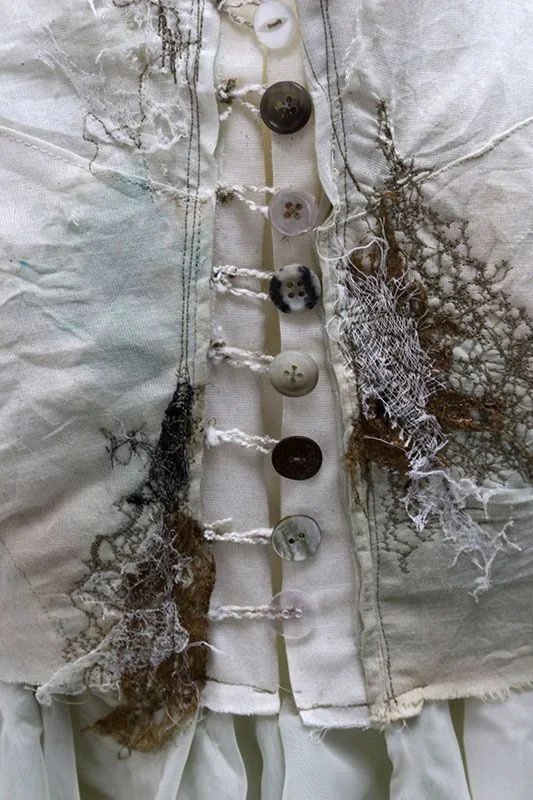
In her nineties, Louise Bourgeois began cutting into fabrics she had kept for decades.
Nightgowns. Scarves. Household cloth. Linen from her wedding trousseau, still carrying the initials of the woman she had been when she married.
She cut them apart and stitched them into something else.
I love this.
Not because the past has been left behind.
Almost the opposite.
The cloth remains what it was.
It has touched the body. Lived in the house. Belonged to a marriage. Been folded away.
And now it becomes another form. A book to be read.
I don’t think we ever abandon the past.
There is no woman underneath it who was never touched by what happened.
What interests me is what experience becomes after the life that made it has moved on.
What can be cut apart.
What can be reassembled.
What still carries the shape of where it came from.
THE BODY WAS HERE
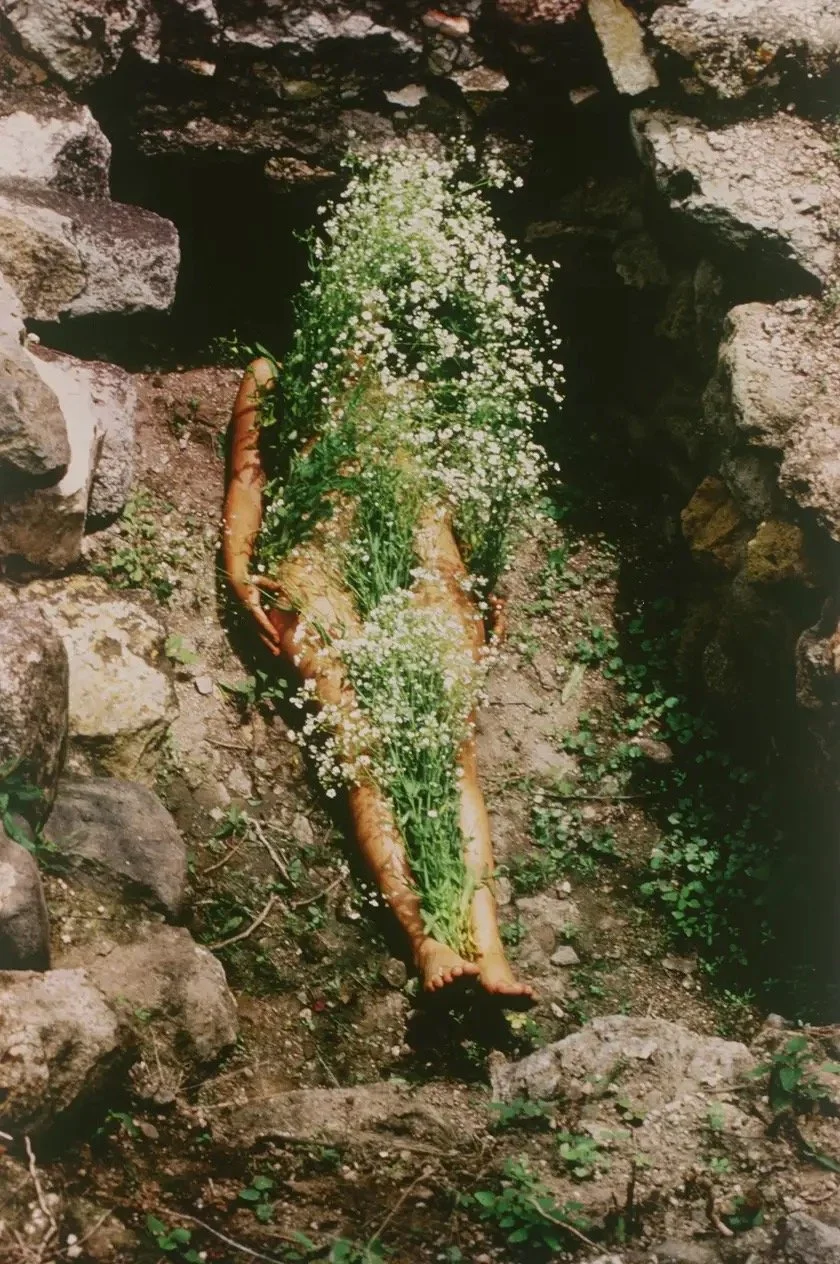
ANA MENDIETA, SILUETA SERIES.
Ana Mendieta made the Silueta works in earth, sand, flowers, grass, fire.
Sometimes there is a body.
Sometimes only its outline.
A woman-shaped absence in the landscape.
Then weather comes.
Water.
Wind.
Time.
The earth takes the image back.
Mendieta called the work a dialogue between the landscape and the female body.
She had left Cuba as a child.
Exile, belonging, body, earth.
They move through the work without needing to be separated neatly from one another.
I always want to stay with the outline longer than seems reasonable.
To look.
There is something almost unbearable about an outline.
The body is gone.
And there it is.
She was here.
There are people who leave our lives and remain extraordinarily present.
There are houses we no longer live in that the body still seems to remember.
There are words spoken once that continue speaking long after the person who said them has forgotten.
Sometimes a woman enters a room she has never seen before and something in her prepares itself for a room from long ago.
The body has its own archive.
The Jungian analyst Marion Woodman once said:
“That voice is in the cells.”
That sentence stops me.
Because some voices travel so far inward that eventually we stop hearing them as voices.
A look.
A silence.
Approval.
Disappointment.
The tiny change in somebody’s face when we said something they did not want to hear.
We learn quickly in relationship.
Often long before we understand what we are learning.
A woman’s interior life is never made entirely in private.
It is shaped in rooms, in relationships, in what is spoken, what is rewarded, and what nobody ever says aloud.
An idea about goodness can arrive through somebody we love.
So can an idea about appetite.
Sex.
Anger.
Usefulness.
What makes a woman admirable.
What makes her difficult.
Years later the original moment may be impossible to find.
The arrangement remains.
Perhaps this is why recognition can be so strange.
You discover that something you had always called personality has a history.
That a certainty has ancestors.
That a voice you thought was yours entered by another door.
SOMETHING HEARD - Song to the Siren
This Mortal Coil
I’ve been listening to Song to the Siren as I write this letter.
There is something in it I don’t want to explain.
Something about the way a person can be gone and still alter the shape of a room.
Listen here if you want to:
Song to the Siren
Williams eventually begins writing in her mother’s blank journals.
In pencil.
I keep thinking about the pencil too.
The possibility of erasure.
The small pile of shavings.
A pencil sharpened over and over until one day there is almost nothing left to hold.
Perhaps I will come back to that another time.
For now I keep returning to the shelves.
All those beautiful books.
A mother’s life expected inside them.
Blank pages instead.
And a daughter reading the blankness.
What do we inherit from what was never said?
What forms around a silence?
What stays behind after the original thing has gone?
I think these are questions I have been circling for most of my working life.
Sometimes an old certainty becomes visible again as something we once learned.
A rule.
An expectation.
A way of moving through the world.
For a second, there is a little space around it.
Enough perhaps to wonder:
Is this mine?
Do I still believe it?
Do I still want to live here?
ONE QUESTION TO CARRY
What have you come to call yourself that, on closer listening, might have a history?
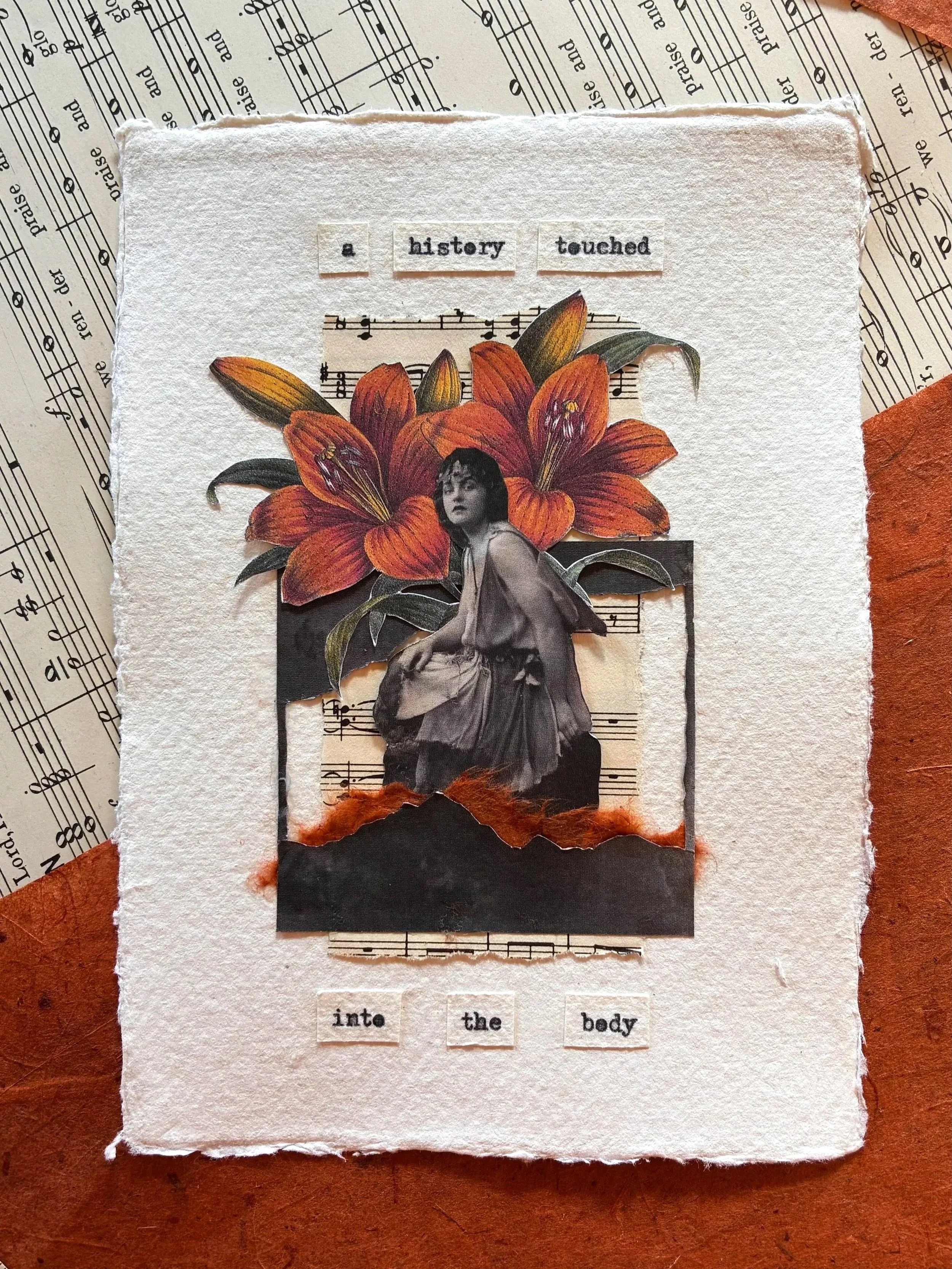
FROM THE HOUSE
WHERE LOVE GOES
A 2027 women’s retreat
Some endings happen once. Others go on happening inside us.
Where does love go when there is nowhere left for it to live between two people?
In 2027, Ames of @thetenderletters and I are creating a four- or five-day women’s retreat around what remains after a relationship has ended in the world, but not yet inside a woman.
The ending might be a love affair, a marriage, an estrangement, the death of a parent, or another relationship whose outer form has gone while something of it continues inside us.
It began with Anne Carson’s The Glass Essay, Emily Brontë, the moors, and questions we keep returning to.
We want to make room for grief, attachment, erotic life, longing, memory, imagination, the unlived, and the versions of ourselves that belonged to a relationship that is no longer there.
The work will move between poem and body, image and imagination, room and moor.
There will be writing and collage, guided imaginal journeys, ritual, mythic work, conversation and silence, as different ways of following what remains when ordinary language reaches its edge.
A line from a poem might open a journey. Something encountered in imagination might return through image or making. A story may find the place explanation cannot. Work begun in one form may continue somewhere entirely unexpected.
I will bring the psychological, Jungian and imaginal work that runs beneath Hag & Bone. Ames will bring the body, image, collage and making of The Tender Letters. We want the work to cross between us, each practice disturbing and deepening the other.
We are looking towards Haworth and the moors, or the wild Devon countryside, for the house that will hold us.
If you can already feel yourself leaning towards this, leave your name below.
Ames and I are really looking forward to seeing who wants to gather and dream with us.
Lavinia 🤍